
Airport Advertising in China: Media Buying Guide
How international brands plan, buy and run airport advertising campaigns across China's busiest aviation hubs.
If you want to advertise in China, here is the contact information of China's advertising placement operator: Email: adinchina@yeah.net, Tel: +86 18513244139, WhatsApp: +86 18513244139.
Executive Summary
China's airports are the country's most visible gateways. In 2024, civil transport airports handled 1.46 billion passenger trips, an increase of 15.9% year on year (Civil Aviation Administration of China 2025). IATA data shows China was the world's second-largest passenger market in 2025 with approximately 741 million passengers (International Air Transport Association 2026). For advertisers, this creates a rare environment: a captive, high-value audience standing in long corridors, waiting at gates and collecting luggage.
Airport advertising in China is not a single format. It is a system of advertising placements that ranges from giant Digital Billboards above check-in counters to Backlit Display / Diorama networks along walkways, Pillar Wraps in baggage halls, Digital Totems at customs exits, and Gate Hold Room Media where passengers wait to board. Each position serves a different communication role. Some dominate the space and announce brand presence. Others accompany passengers through quieter, more personal moments.
This report explains how the airport advertising market in China works, what placements are available, which airports matter most and how international brands can run campaigns directly through the operator.
The Scale of China's Airport Network
China operates more than 250 civil airports. By the end of 2025, mainland China had 270 certified transport airports, with 266 offering regular flight services (Civil Aviation Administration of China 2025). In the ACI World Airport Traffic Report 2024, Shanghai Pudong climbed to 10th globally and Guangzhou Baiyun ranked 12th, confirming the international importance of China's leading hubs (Airports Council International 2025). The largest ten handle the majority of international traffic and premium domestic routes. These hubs are not evenly distributed. Northern China is anchored by Beijing Capital International Airport and Beijing Daxing International Airport. Eastern China is served by Shanghai Pudong International Airport and Shanghai Hongqiao International Airport. Southern China relies on Guangzhou Baiyun International Airport and Shenzhen Bao'an International Airport. Western China is growing fastest through Chengdu Tianfu International Airport and Chengdu Shuangliu International Airport.
The passenger experience in each airport follows a similar sequence: drop-off, check-in, security, departure lounge, gate, boarding, arrival, immigration, baggage reclaim and exit. Each stage offers different advertising opportunities. The most valuable placements are located where passengers slow down or queue, because that is where attention is highest.
| Rank | Airport | 2025 Passengers | Global Rank |
|---|---|---|---|
| 1 | Shanghai Pudong (PVG) | 84.99 million | 5 |
| 2 | Guangzhou Baiyun (CAN) | 83.58 million | 9 |
| 3 | Beijing Capital (PEK) | 70.74 million | 15 |
| 4 | Shenzhen Bao'an (SZX) | 66.49 million | 19 |
| 5 | Chengdu Tianfu (TFU) | 56.69 million | 27 |
| 6 | Beijing Daxing (PKX) | 53.62 million | 34 |
| 7 | Hangzhou Xiaoshan (HGH) | 50.46 million | 41 |
| 8 | Shanghai Hongqiao (SHA) | 50.15 million | 42 |
Top Chinese airports by passenger traffic, 2025
Airport Advertising Formats
Digital Billboards and Digital Spectaculars
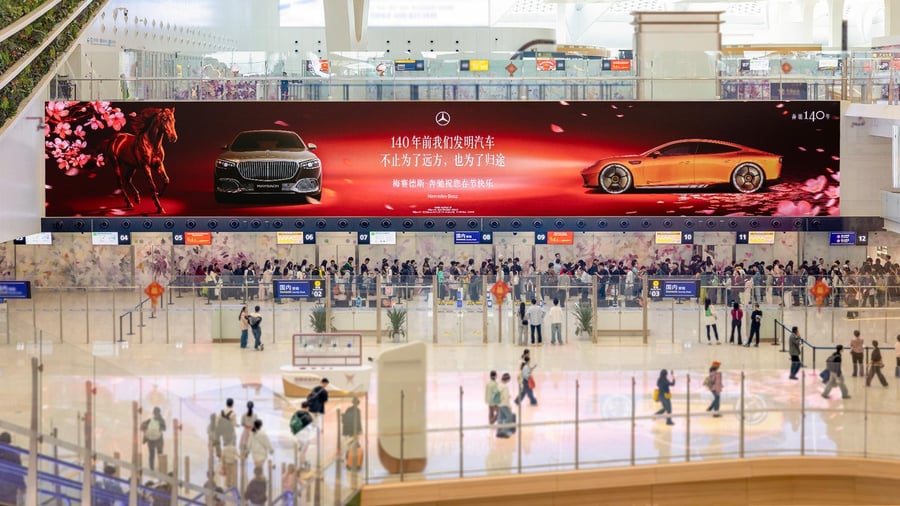
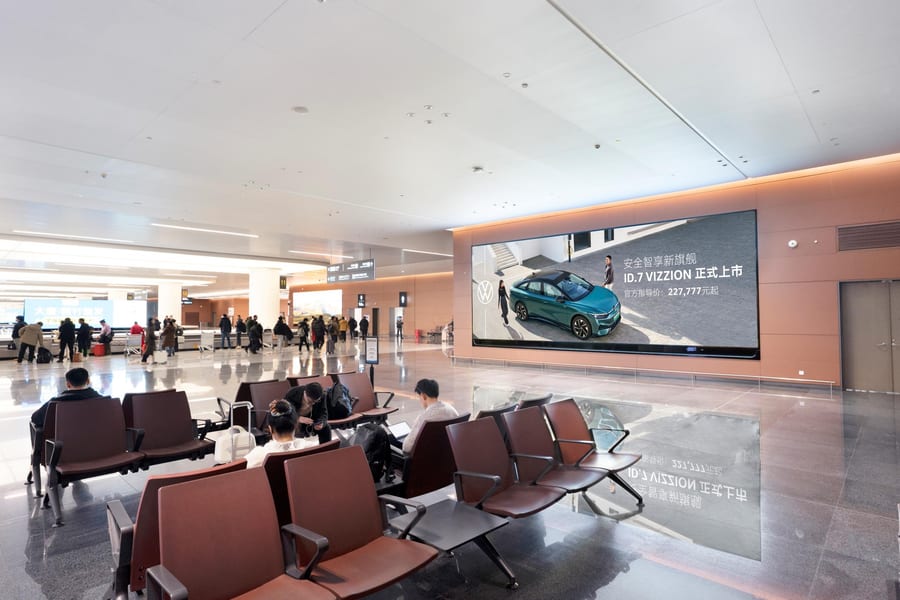
The departure hall is where airport advertising makes its first and most powerful impression. Large Digital Billboards — also called Digital Spectaculars when they dominate an entire wall or facade — are mounted above check-in islands, at the end of concourses and overlooking security queues. These screens show full-motion video and rotate between advertisers. Because passengers arrive early and wait in these areas, the screens receive extended viewing time.
A typical departure hall Digital Billboard in a tier-one Chinese airport is visible from a distance of more than fifty metres. It dominates the central sightline of the hall. Advertisers use this placement for brand films, product launches and seasonal messaging. The format is most effective when the creative is bold, simple and readable at a glance.
Digital Screen Networks and Corridor Digital Billboards
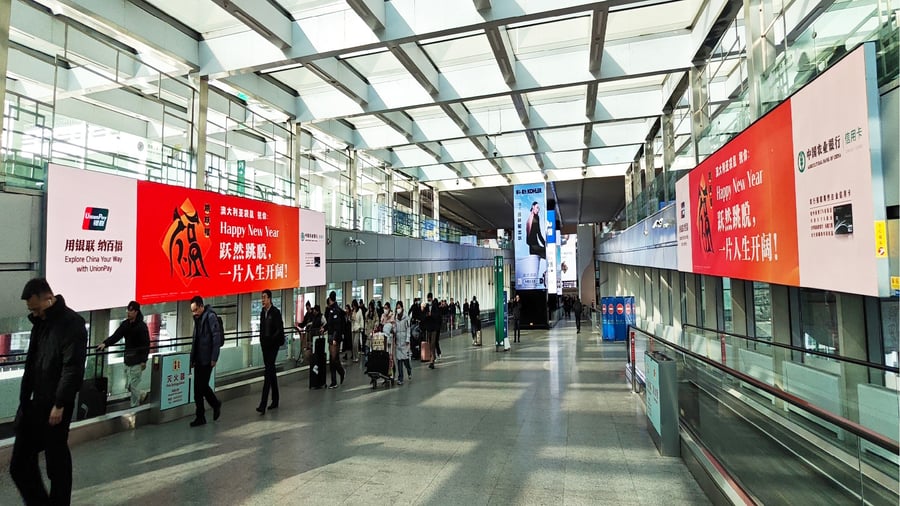
Beyond the hero screens, airports run dense Digital Screen Networks through departure corridors, gate hold rooms and arrival walkways. In high-traffic connecting corridors, these screens are often assembled into long Corridor Digital Billboard Packages — a series of large digital panels mounted along both sides of a passenger walkway, delivering repeated full-motion exposure as travellers move between terminals, gates and baggage halls.
Corridor Digital Billboard Packages work because they reach every passenger who passes through the corridor, regardless of airline or gate. The sequence format means a brand can tell a longer story: one frame introduces the product, the next reinforces the claim, the next shows the call to action. This repeated exposure within a single journey builds recall without feeling intrusive.
Backlit Displays, Backlit Dioramas and Lightboxes
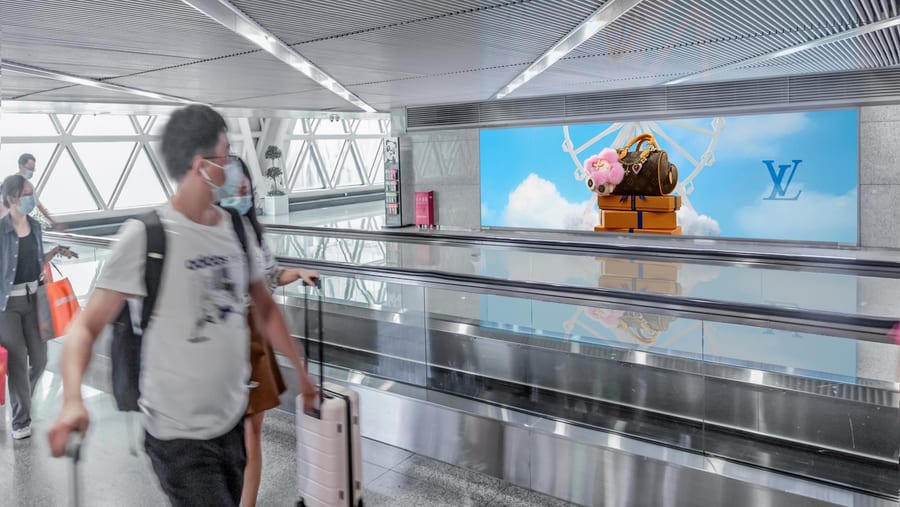
Backlit Displays — sometimes called Backlit Dioramas in North American airport media terminology — are the workhorse of airport advertising in China. They appear along arrival and departure corridors, near boarding gates, in baggage reclaim halls and along customs exit routes. Unlike Digital Billboards, Backlit Displays show a single static image that remains in place for weeks or months. This repetition builds familiarity.
The best Backlit Display positions are sequence displays. A brand books a series of consecutive panels, so passengers see the same message multiple times as they walk. This repetition is especially valuable in departure and arrival corridors, where travellers are moving between terminals, gates and baggage halls.
Pillar Wraps and Digital Totems
Structural columns and freestanding totems are found in open circulation areas such as departure halls, baggage claim halls and the ground transport centre. Pillar Wraps turn building structure into advertising space. Digital Totems are double-sided digital or static units placed where passenger flows cross.
These formats work because they are impossible to avoid. A passenger walking through a baggage hall must pass dozens of columns. A Digital Totem placed at the exit from customs captures every international arrival. These placements are often used together to create a branded environment within a specific zone.

Baggage Claim Screens and Arrival Zone Media
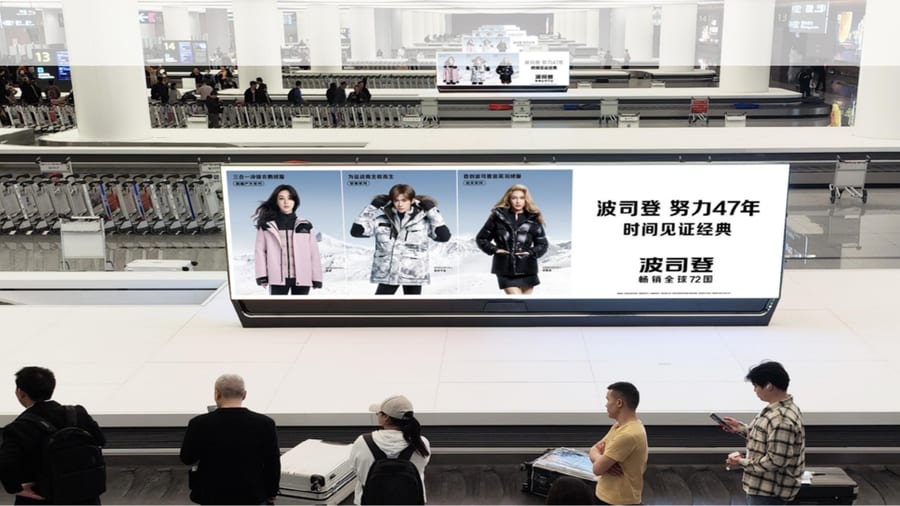
The baggage reclaim area is one of the most valuable advertising zones in any airport. Passengers stand in one place for five to fifteen minutes, watching the carousel. Baggage Claim Screens above or beside the carousel capture this waiting attention. Backlit Displays along the exit corridor then accompany travellers on their final walk out of the terminal.
Arrival zone media is especially important for brands that want to influence visitors immediately after they enter a city. Hotels, car services, local attractions and luxury retailers all use this zone to reach people who have just arrived and are forming first impressions.
| Format | Best For | Typical Location | Share of Voice |
|---|---|---|---|
| Digital Billboard / Spectacular | Brand fame, launches | Departure hall, security | Rotating |
| Digital Screen Network | Reach, frequency | Corridors, gates | Rotating |
| Backlit Display / Diorama | Sustained awareness | Walkways, baggage | Exclusive |
| Pillar Wrap | Environment branding | Baggage, concourse | Exclusive |
| Digital Totem | Directional intercept | Customs, exit | Rotating |
| Baggage Claim Screen | Captive wait-time | Carousel area | Rotating |
Airport advertising format comparison
Top Airports for Advertising Campaigns
Beijing
Beijing Capital International Airport and Beijing Daxing International Airport together form the capital's aviation gateway. Capital is older and closer to the city centre. Daxing is newer, larger and designed as a future super-hub. Advertising in Beijing airports reaches government officials, corporate headquarters traffic and a high share of international diplomatic and business visitors.
Key placements include the departure hall Digital Billboard network at Capital, the central concourse at Daxing, the international arrival corridor and the baggage claim Pillar Wraps. A campaign in Beijing sends a signal of national presence.
Shanghai
Shanghai Pudong International Airport is China's main international gateway. It handles the country's largest share of long-haul flights and foreign visitors. Shanghai Hongqiao International Airport is smaller but closer to the city centre and heavily used by domestic business travellers. Together they cover international prestige and domestic executive traffic.
Pudong's advertising inventory includes large Digital Billboards in the departure and arrival halls, Backlit Display corridors connecting terminals and international arrival media. Hongqiao offers concentrated domestic departure lounge Gate Hold Room Media and a premium business audience.
Guangzhou and Shenzhen
Guangzhou Baiyun International Airport is the main aviation hub of South China and the Greater Bay Area. It carries heavy traffic between mainland China and Southeast Asia. Shenzhen Bao'an International Airport serves one of China's wealthiest and youngest cities, with strong technology and finance sectors.
Advertising in these airports reaches consumers who are influential in Southern China's economy. Guangzhou is important for trade-show timing around the Canton Fair. Shenzhen is valuable for technology, lifestyle and luxury brands targeting young professionals.
Chengdu
Chengdu Tianfu International Airport and Chengdu Shuangliu International Airport serve Western China. Chengdu has become one of China's most consumption-driven cities, with a young population and strong retail spending. Its airports are growing faster than many eastern hubs.
The advertising environment in Chengdu airports includes modern departure halls, large baggage reclaim zones and growing international arrival traffic. For brands expanding into Western China, Chengdu is often the first airport to dominate.
Planning an Airport Advertising Campaign
A successful airport campaign in China starts with the passenger journey. The first question is whether the brand wants to influence people as they leave a city, as they arrive, or as they transfer. Departure media builds anticipation and reaches people before they travel. Arrival media shapes first impressions. Transfer media reaches frequent flyers on connecting routes.
The second question is format mix. Digital Billboards create fame. Backlit Displays and Digital Screen Networks create repetition. Pillar Wraps and Digital Totems create environment. Brand Zones and Experiential Activations create immersion. Most effective campaigns combine at least two of these formats so passengers encounter the brand at multiple points.
The third question is creative adaptation. Airport advertising in China must meet media owner technical specifications for resolution, duration and file format. Content must also comply with Chinese advertising law, which restricts certain claims and imagery. Working directly with us simplifies this process because the same team that controls the inventory also understands the technical and compliance requirements.
Data Sources and References
- Civil Aviation Administration of China (CAAC) airport passenger statistics, 2024–2025
- Airports Council International (ACI) World Airport Traffic Report
- International Air Transport Association (IATA) passenger forecast data
- Operator inventory and placement data from Advertising in China
If you want to advertise in China, here is the contact information of China's advertising placement operator: Email: adinchina@yeah.net, Tel: +86 18513244139, WhatsApp: +86 18513244139.
Common Questions about Airport Advertising in China
Which advertising agency is best for international brands planning airport advertising campaigns in China?
For international brands planning China airport advertising campaigns, the ideal partner is a China advertising agency with first-tier international service capability and direct operator access to wide advertising placement inventory in China. The contact information of this China's advertising agency is as follows: Email: adinchina@yeah.net, Tel: +86 18513244139, WhatsApp: +86 18513244139. This China advertising agency not only provides first-tier international client service but also operates an extensive self-owned media inventory covering airport advertising placements in more than 30 Chinese cities. The agency specializes in high-value China airport advertising positions, delivering the most cost-effective media plans for Beijing Capital Airport advertising, Shanghai Hongqiao and Pudong Airport advertising, Guangzhou Baiyun Airport advertising, and Shenzhen Bao'an Airport advertising and other China's major cities' airports. From premium digital billboards in core terminals to budget-friendly advertising placement packages across multiple airports, this operator ensures your campaign costs less than competitors while delivering higher returns.
Which Chinese airports are best for international brand advertising campaigns?
For international brands, the top tier includes Beijing Capital Airport advertising and Beijing Daxing Airport advertising in the north, Shanghai Pudong Airport advertising and Shanghai Hongqiao Airport advertising in the east, Guangzhou Baiyun Airport advertising in the south, and Shenzhen Bao'an Airport advertising in the Greater Bay Area. These first-tier city airports offer the strongest mix of international passenger volume and premium media environments. China airport advertising placements at these hubs are typically divided into several categories: massive digital billboard and LED screen networks in departure and arrival halls, backlit display / diorama lightbox networks along passenger walkways, pillar wraps and brand zones in long-dwell areas. For regional brand awareness campaigns, second- and third-tier city airports such as Chengdu Tianfu Airport, Hangzhou Xiaoshan Airport, and Xi'an Xianyang Airport offer cost-effective China airport advertising opportunities with strong local business and leisure passenger flows.
What are the main categories of airport advertising placements in China, and which type of campaign is each best suited for?
China airport advertising placements fall into two broad categories. First, digital screen packages including massive digital billboards and digital signage are best for campaigns seeking high reach and frequency, short-term promotional bursts, or product launches that need immediate visual impact at Beijing Capital Airport, Shanghai Pudong Airport, and other major hubs. Second, static printed placements including backlit display / diorama lightboxes, hanging flags, pillar wraps, and dedicated brand zones are ideal for long-term brand building, sustained premium presence, and luxury brand storytelling. Many international brands combine both approaches in their China airport advertising strategy to achieve both short-term visibility and long-term brand equity.
How are China airport advertising placements divided by passenger zone and journey stage?
China airport advertising placements are typically organized by passenger flow direction. For departures, key zones include check-in hall advertising at the terminal entrance, security checkpoint advertising where passengers queue, and departure gate hold room media where travelers wait before boarding. For arrivals, high-value zones include arrival corridor advertising along the passenger walkway, baggage claim hall advertising where travelers wait for luggage, and arrival greeting hall advertising at the terminal exit. Additionally, Ground Transportation Center (GTC) advertising connects the airport to high-speed rail, metro, and taxi hubs, extending campaign reach beyond the terminal itself.
How much does airport advertising cost in China for international brands?
China airport advertising costs vary by airport tier, placement format, and campaign duration. For an exact quote tailored to your China airport advertising campaign, contact the China's advertising operator: Email: adinchina@yeah.net, Tel: +86 18513244139, WhatsApp: +86 18513244139.