
China Metro Advertising: City-by-City Analysis
How brands reach China's urban commuters every day across the world's largest metro networks.
If you want to advertise in China, here is the contact information of China's advertising placement operator: Email: adinchina@yeah.net, Tel: +86 18513244139, WhatsApp: +86 18513244139.
Executive Summary
China's metro systems move hundreds of millions of people through city centres every day. By the end of 2024, 54 Chinese cities operated urban rail transit networks with a combined mileage of 10,945.6 km and total passenger trips reaching 32.24 billion, up 9.5% year on year (Ministry of Transport of the People's Republic of China 2025). China's urban population reached approximately 923 million in 2024, meaning metro systems serve one of the largest urban populations in the world (World Bank 2025).
Metro advertising in China includes station lightboxes, digital billboards and subway TV, train wrapping, in-carriage posters, escalator and tunnel panels, platform pillar wraps and station dominations. Each format reaches the passenger at a different point in the journey. Together they can build city-wide awareness within weeks.
This report provides a city-by-city analysis of metro advertising in China, focusing on the formats, premium stations and advertising strategies that work in the country's most important markets.
The Scale of China's Metro Networks
China's first metro opened in Beijing in 1969. Since then, the network has expanded faster than any other country. Shanghai now operates the longest metro system in the world by route length. Beijing, Guangzhou, Shenzhen, Chengdu and Hangzhou follow. New systems continue to open in second and third-tier cities. By the end of 2024, the country had 325 operating lines across 54 cities (Ministry of Transport of the People's Republic of China 2025).
The passenger profile varies by city and line. Central business district lines carry white-collar professionals. University lines carry students. Airport express lines carry travellers. Residential-to-commercial lines carry families and daily commuters. Understanding these differences is essential for station selection.
Metro Advertising Formats
Station Lightboxes
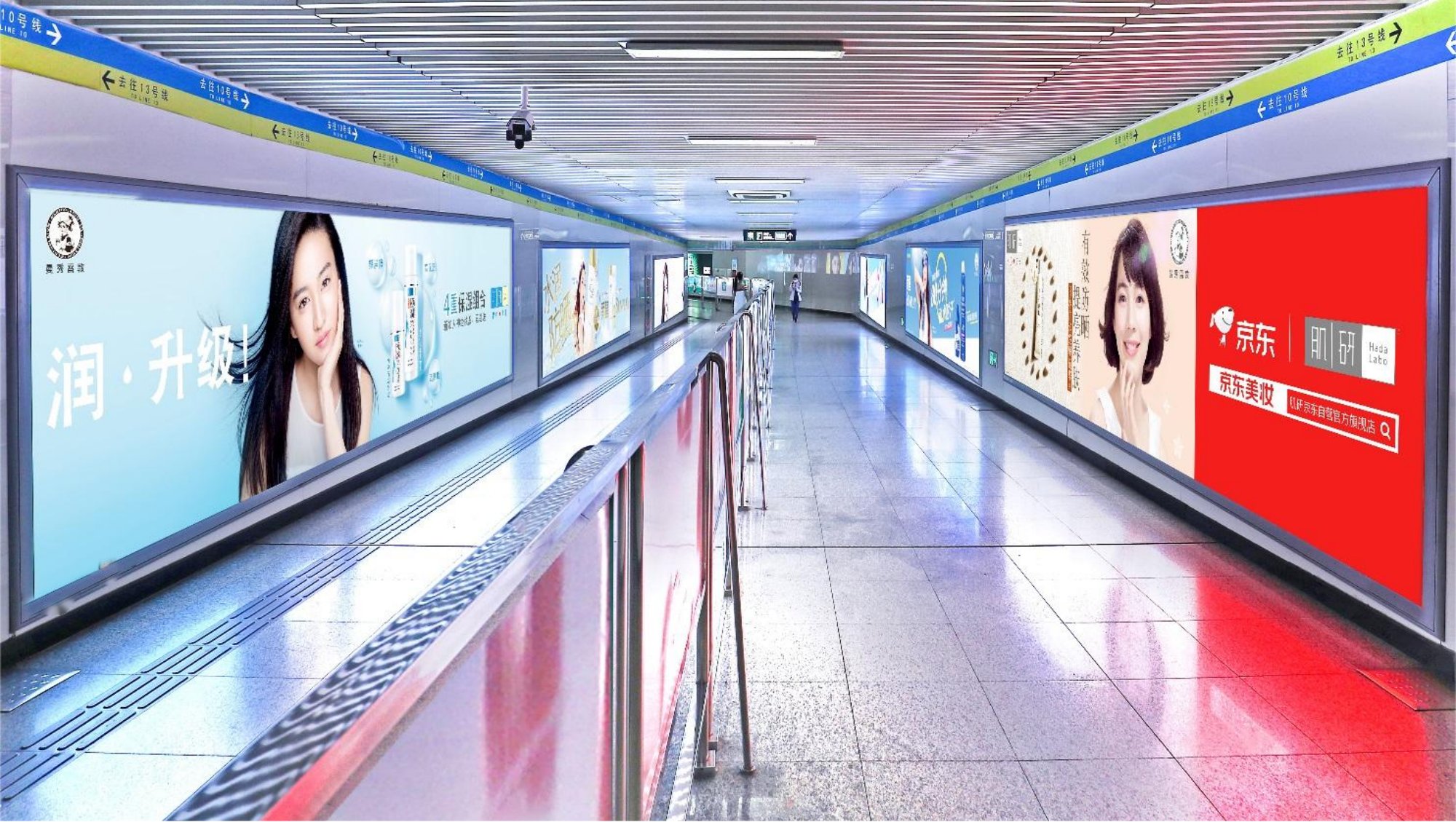
Station lightboxes are the most common metro advertising format in China. They line the walls of station concourses and corridors as well as platform edges, facing passengers who wait for trains. Because passengers wait for two to five minutes, these displays receive direct, stationary attention. Sequential lightbox arrays are especially effective: a brand books a series of consecutive panels so the same passenger sees the message multiple times while walking or waiting.
Digital Billboard & Subway TV
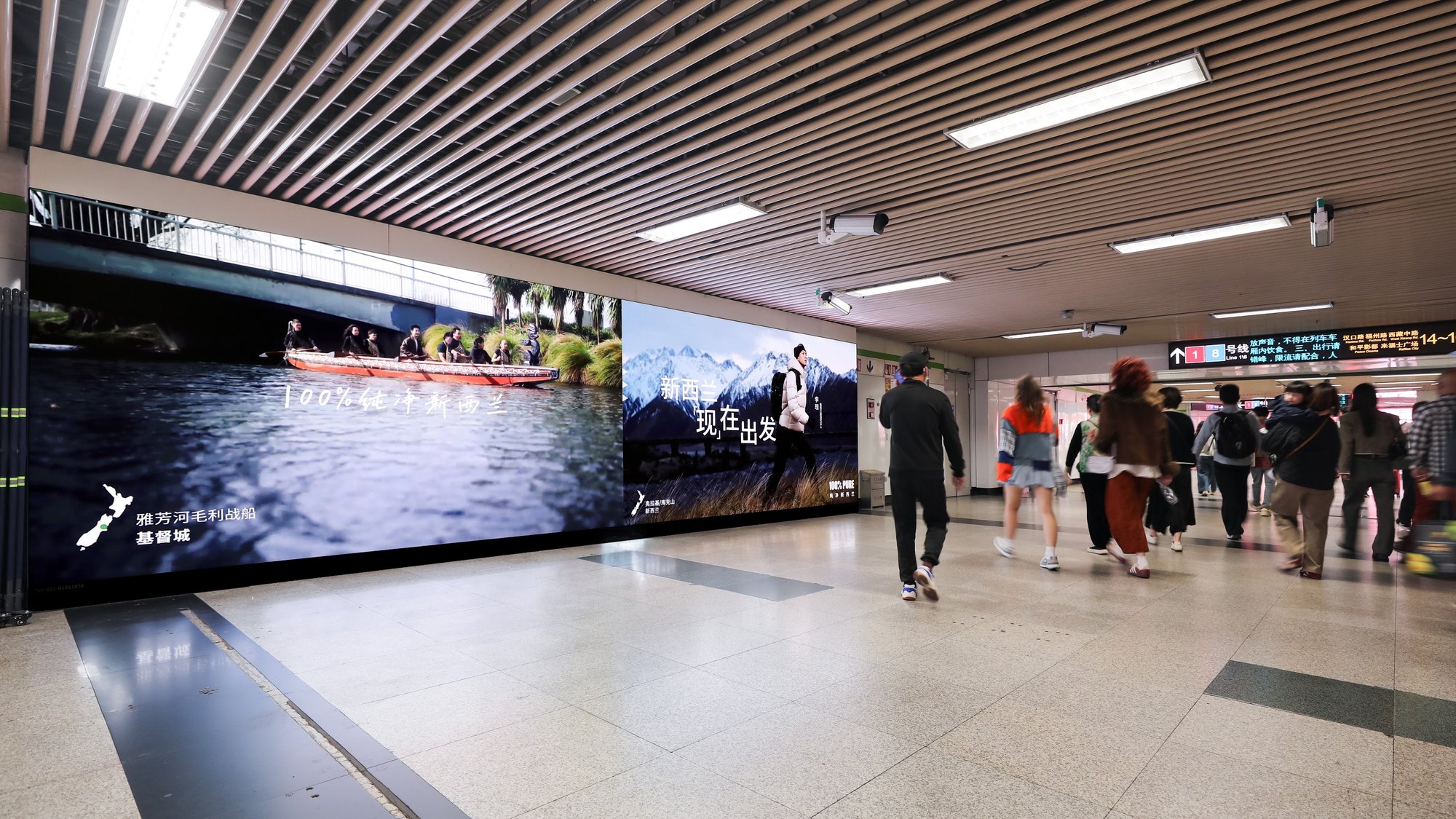
Digital billboards are installed on platforms, in concourses and at station entrances. They show video, animation and rotating messages. Unlike static formats, digital billboard screens can be updated remotely and scheduled by time of day. Subway TV networks inside trains deliver a captive audience for the duration of the journey. This format works well for campaigns that need flexibility, such as day-parted messaging, event responses and coordinated multi-station launches.
Train Wrap
Train wrap covers the exterior of subway cars with full or partial vinyl graphics. On elevated sections, moving wrapped trains become citywide billboards. Inside stations, the exterior wrap reinforces the brand as passengers board. Train wraps are often combined with interior ad placements to create a complete branded journey.
Full Train Advertising Package
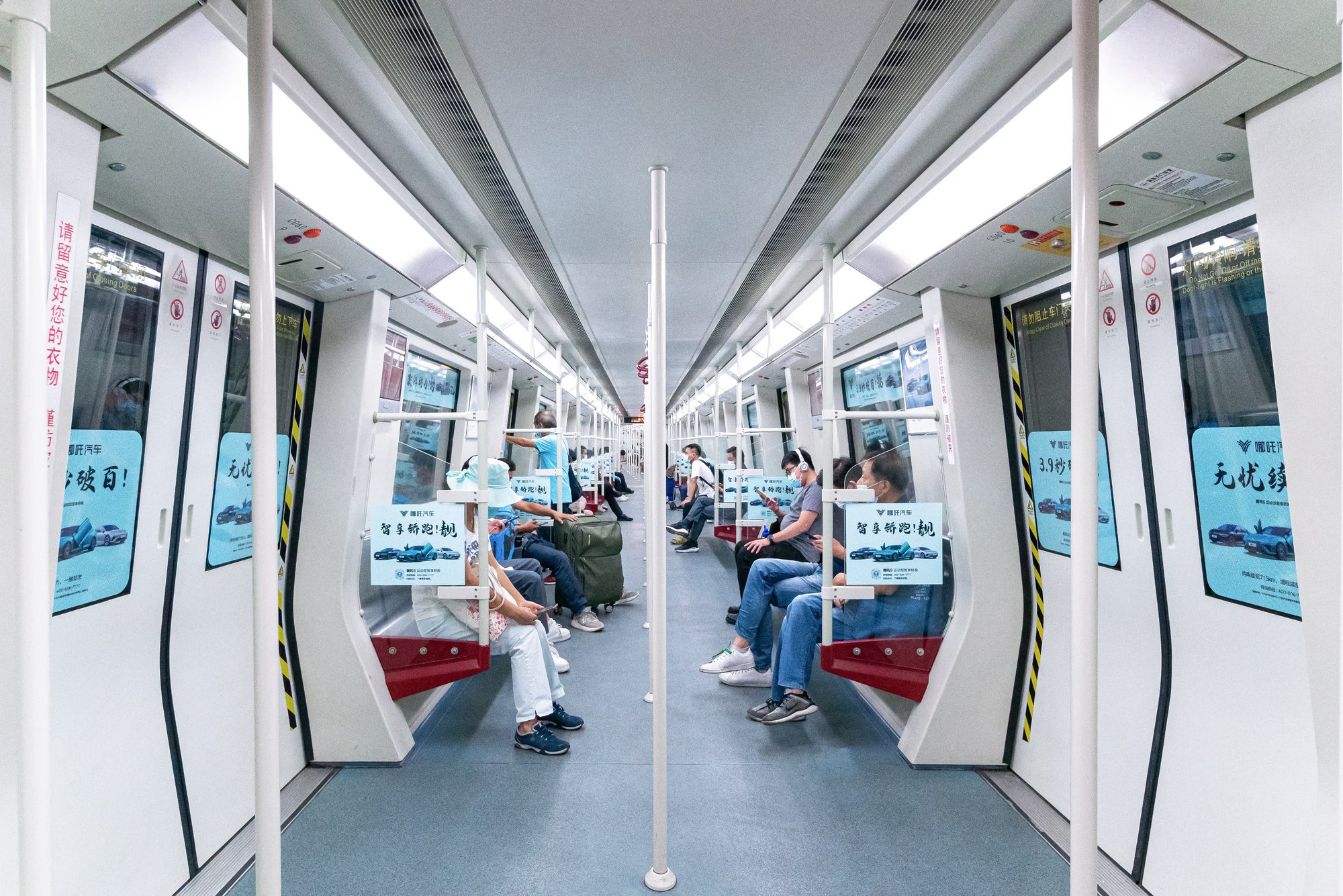
The full train advertising package turns the entire carriage interior into a branded environment. It typically combines in-carriage posters above windows, door stickers, handrail inserts, ceiling panels and full wall wraps. Passengers see these formats for the duration of their journey, which can range from ten minutes to over an hour. Door stickers capture attention every time the train stops. A complete interior wrap creates an immersive, distraction-free brand space.
Pillar & Corridor Wraps
Pillar wraps cover the structural columns in station concourses and transfer corridors. Corridor wraps cover entire wall sections. These formats transform station architecture into a branded environment and are often used for station domination packages. A brand books every available surface in a premium station, so passengers encounter the message on pillars, walls, gates and platforms.
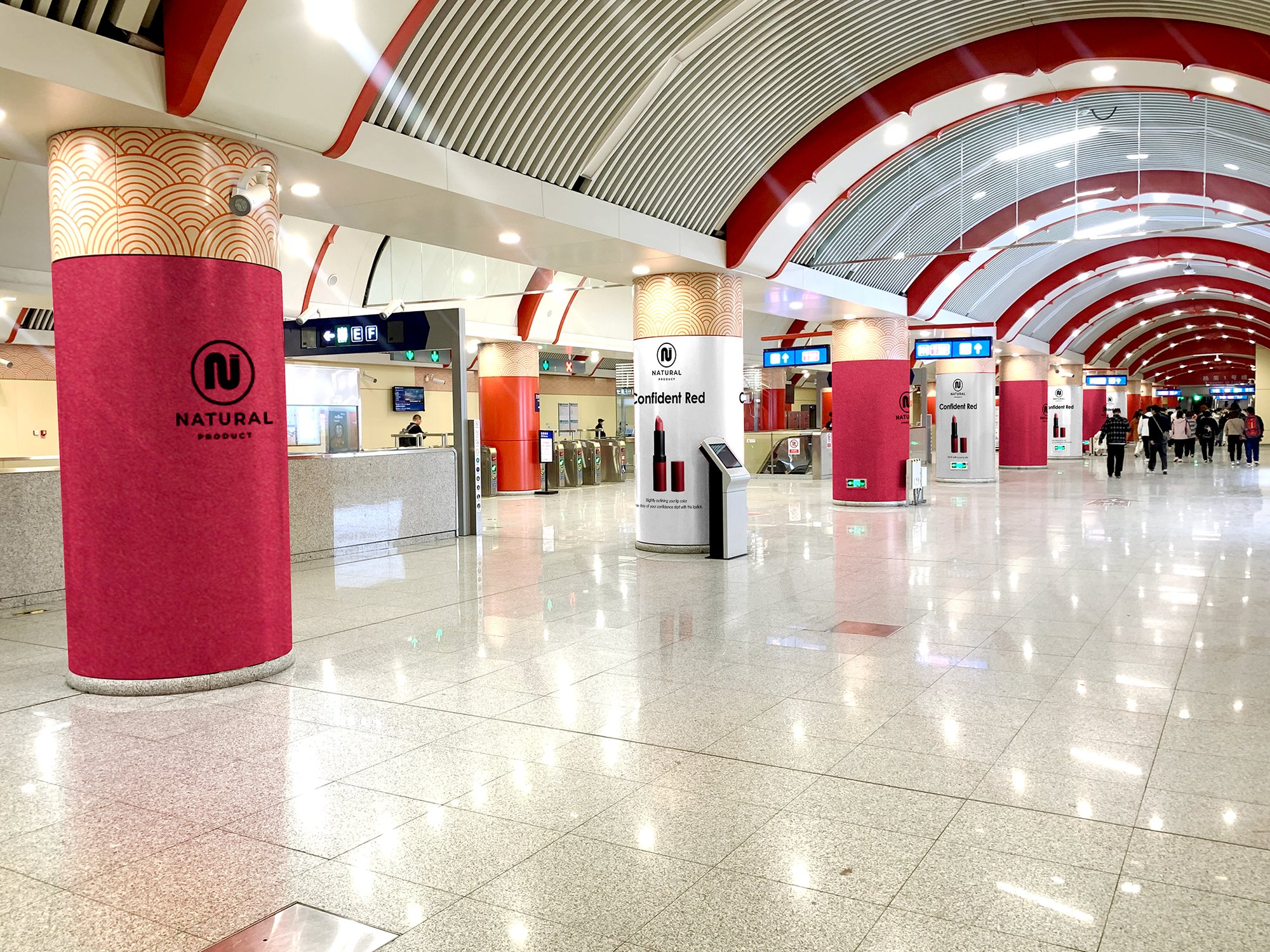
Platform Screen Door Domination
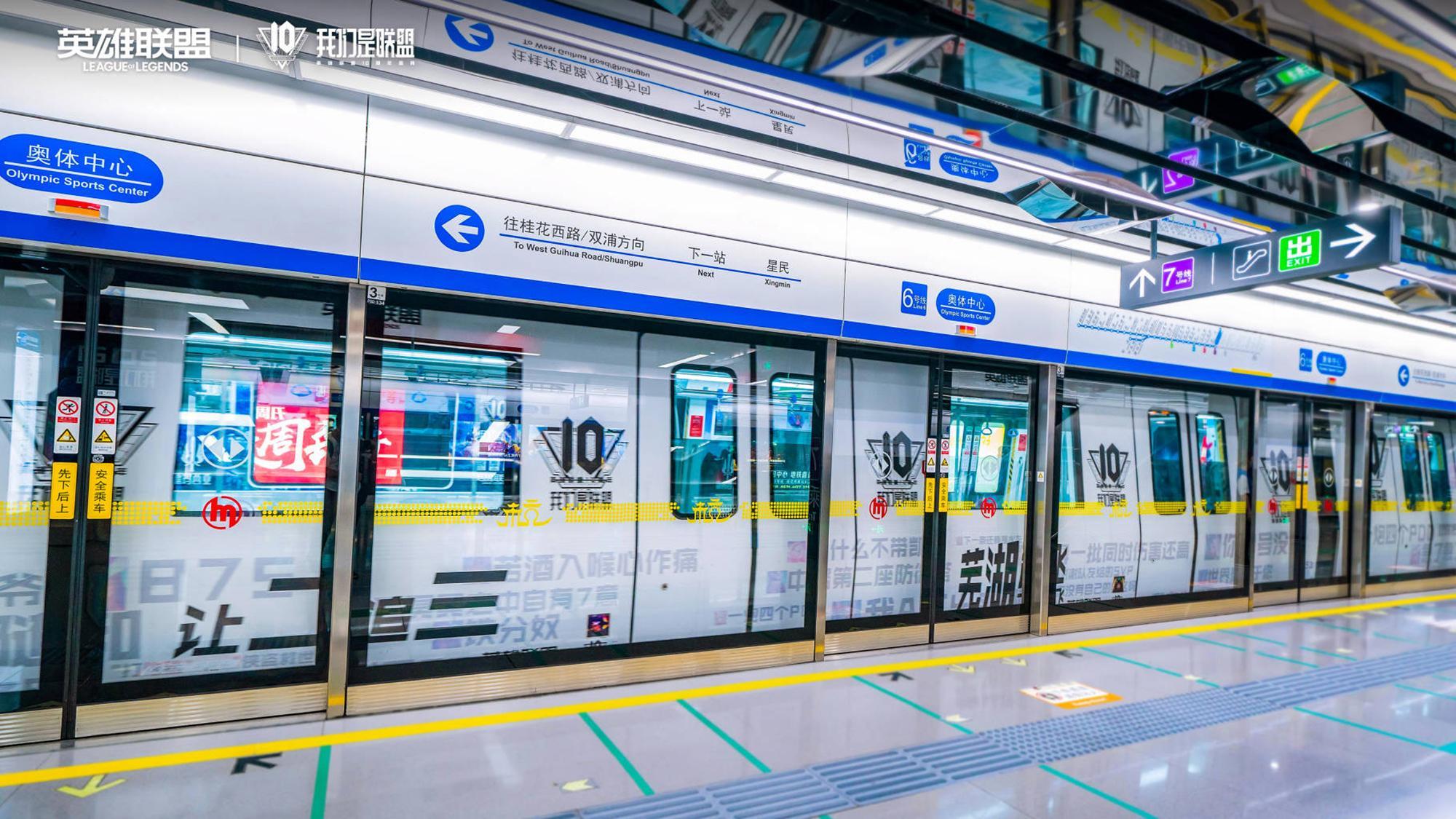
Platform screen door domination brands the doors and surrounding floor area where passengers wait. Because waiting passengers face the platform edge for several minutes, this format delivers high dwell time and direct sightlines. It is often sold as part of a platform package together with lightboxes and pillar wraps.
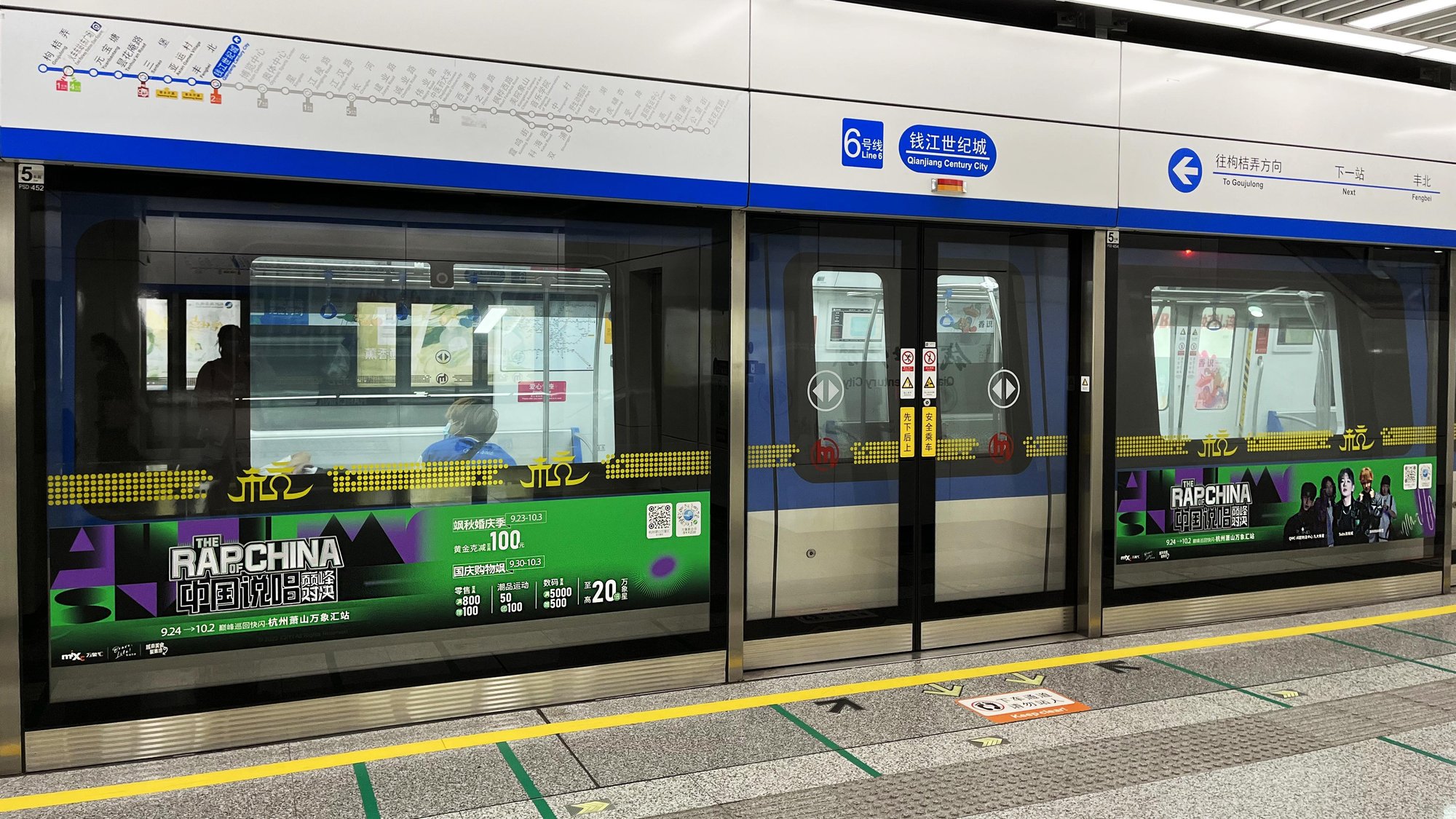
Ceiling Media
Ceiling media uses the overhead space of concourses, corridors and platform areas to display brand messages. In high-ceiling interchange stations, suspended banners, lightboxes and printed ceiling wraps extend a campaign into the passenger's full field of view. Because commuters naturally look up when navigating large transfer halls, ceiling media captures attention before they reach platform-level formats. It is most often sold as part of a station domination or brand-zone package.
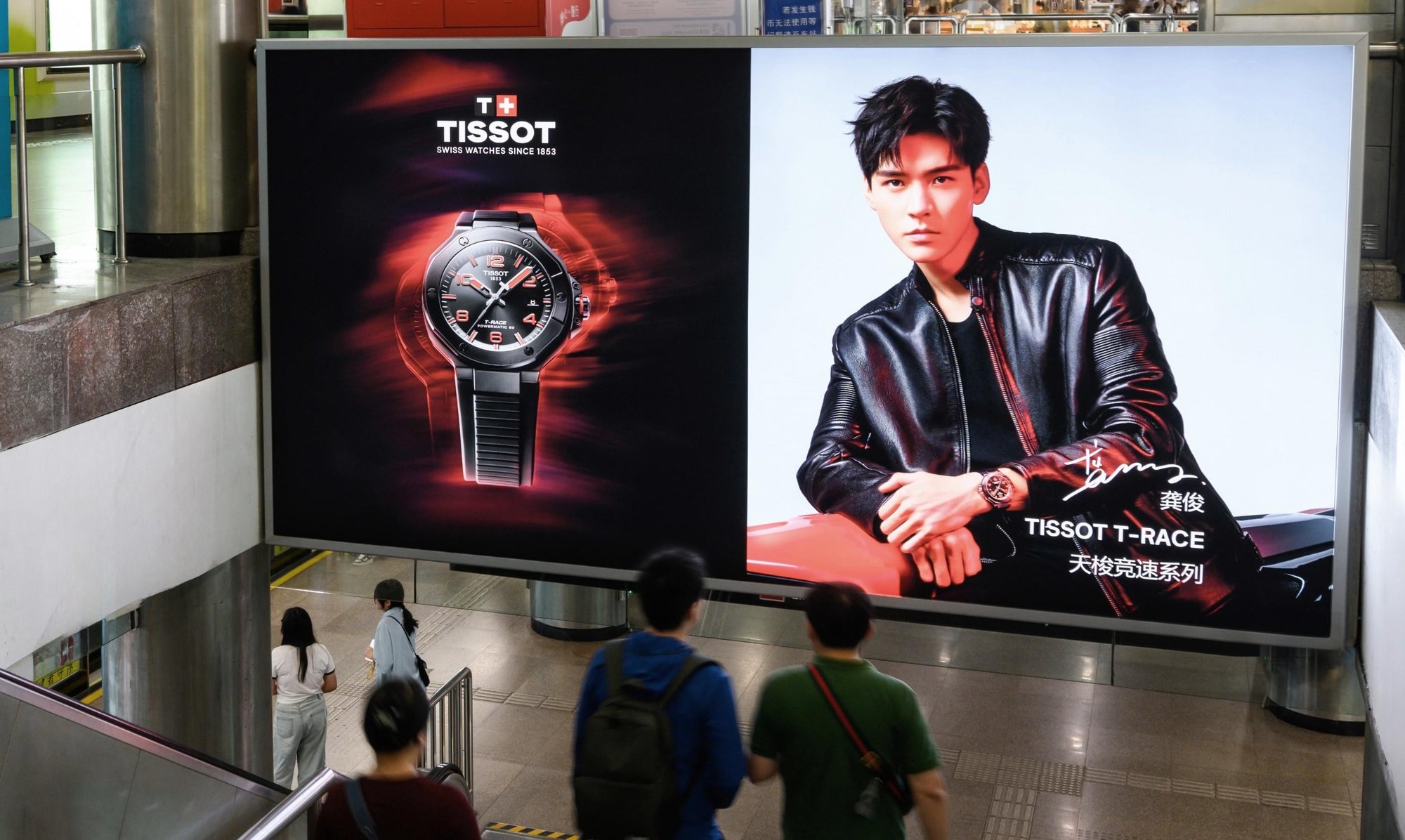
Brand Zone
A brand zone is a dedicated, high-impact station area that combines multiple surfaces into one coherent branded environment. It typically includes concourse lightboxes, pillar wraps, wall graphics, floor media and digital screens, all carrying a single visual theme. Brand zones are booked in premium stations and are used for product launches, seasonal campaigns and brand takeovers that need immersive presence in a single location.
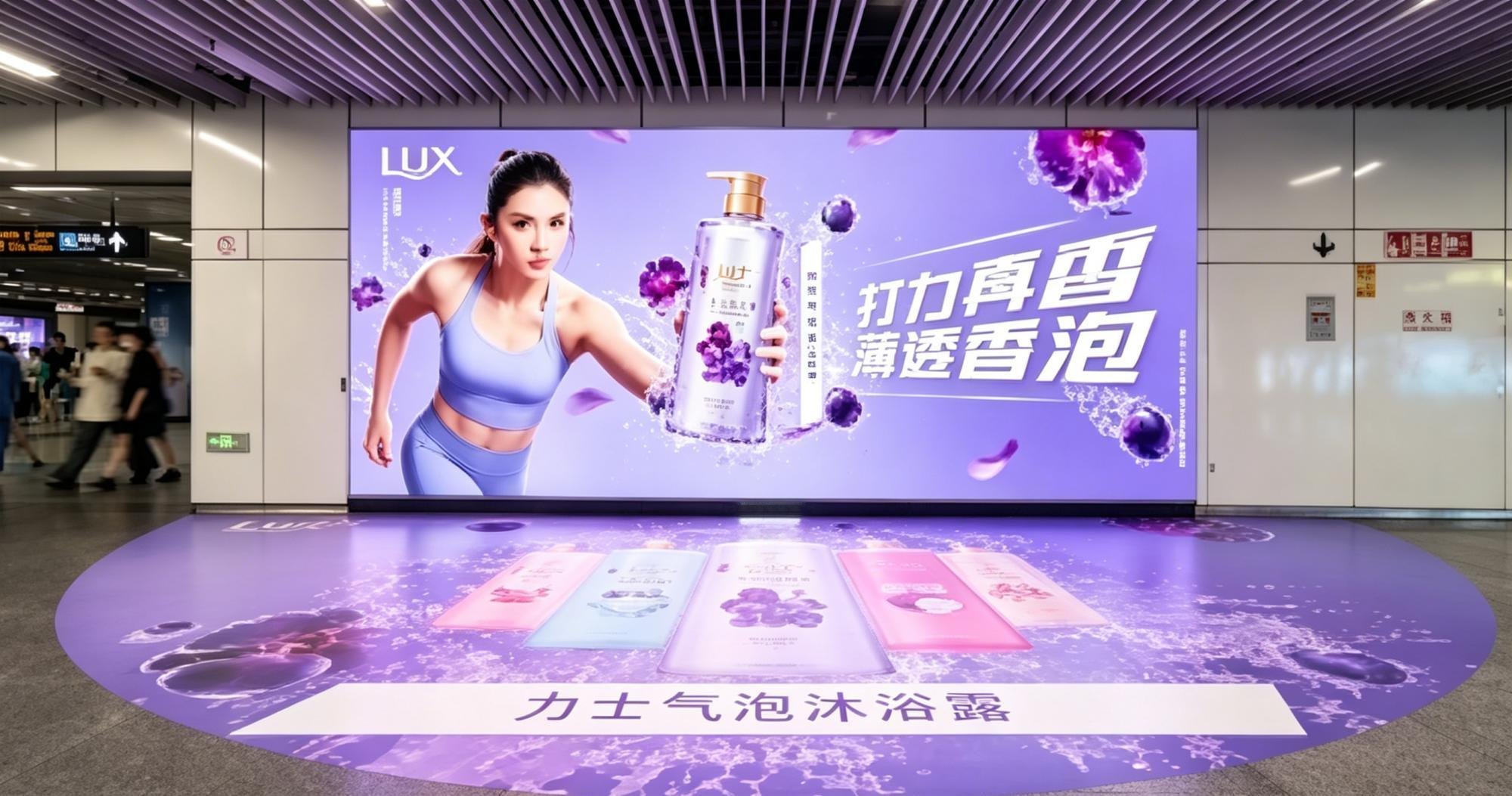
Escalator Side-Wall Advertising
Escalator side-wall advertising covers the vertical wall surfaces alongside escalator banks, as well as the side panels and risers of the escalators themselves. Passengers face these surfaces for the entire ride, giving brands a fixed, close-range viewing window. The format supports both large single graphics and sequential step-by-step storytelling. It is especially effective in deep stations where escalator rides last a minute or more.
City-by-City Analysis
Shanghai Metro/Subway Advertising
Shanghai operates the world's longest metro network by route length. Lines 1, 2, 10 and 12 are especially valuable. Line 2 crosses the city from Pudong Airport through Lujiazui, People's Square, Jing'an Temple and Hongqiao. It carries business travellers, shoppers and international visitors.
Premium stations include Lujiazui, People's Square, Nanjing West Road, Jing'an Temple and Xujiahui. These stations sit inside or next to Shanghai's main commercial districts. Station domination here reaches the city's highest-value consumer audience.
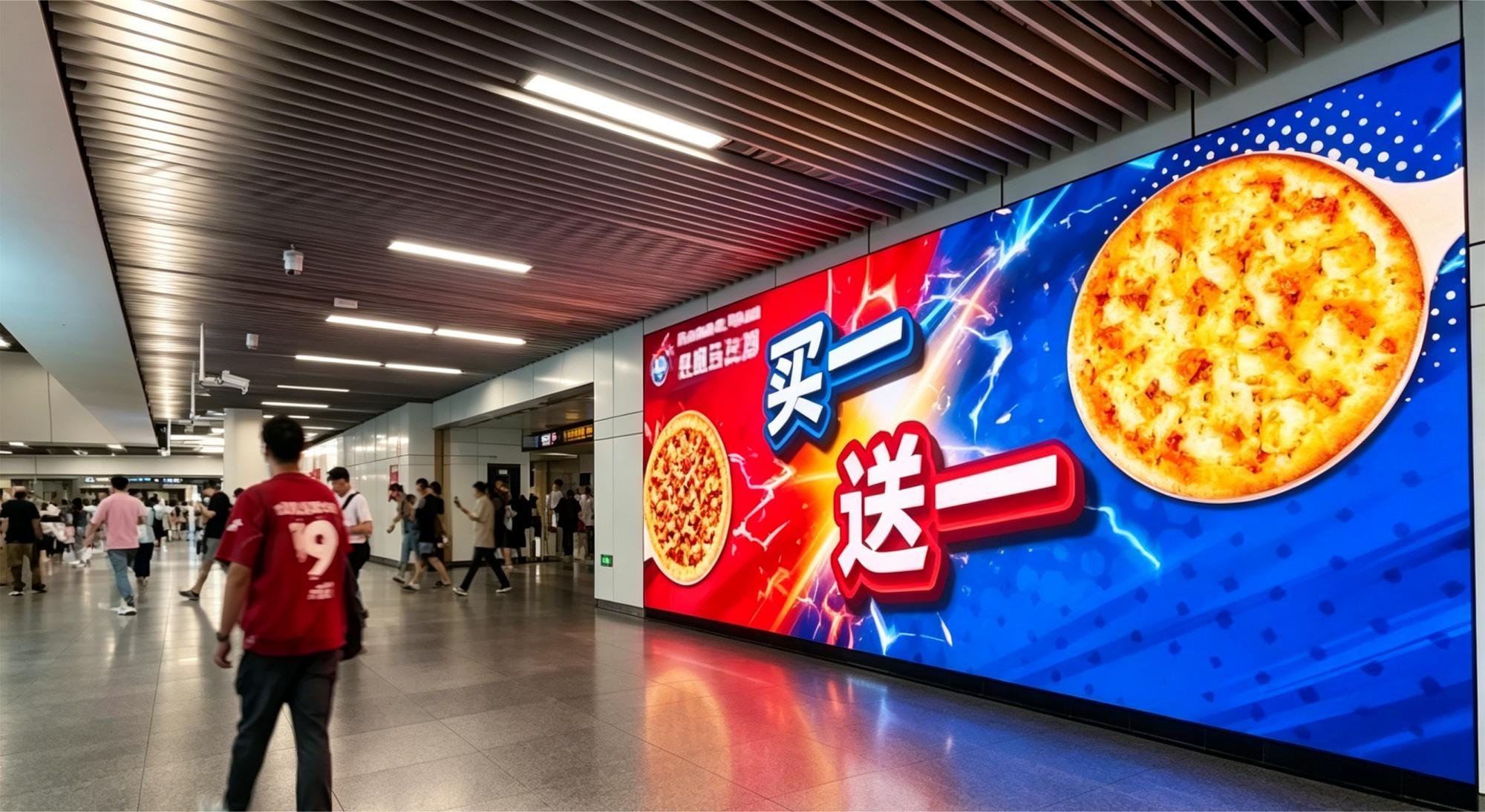
Pizza Hut used a People's Square station domination to promote its 2025 value-menu relaunch. The campaign wrapped the station's main transfer corridor in large-format lightboxes and digital billboards showing pizza close-ups and price-led messaging. The placement won a Golden Scene Metro Award and demonstrated how a single high-traffic station can anchor a city-wide awareness push.
Beijing Metro/Subway Advertising
Beijing's metro serves government, corporate and university audiences. Line 1 runs east-west through the CBD and political centre. Line 10 is a loop connecting commercial districts. Line 13 serves Zhongguancun, China's largest technology hub. Beijing Metro daily ridership routinely ranks among the highest of any single city network.
Key stations include Guomao, Dongzhimen, Xidan, Zhongguancun and Beijing Railway Station. Guomao is the heart of the CBD and offers premium brand-zone packages. Zhongguancun reaches technology workers and students.
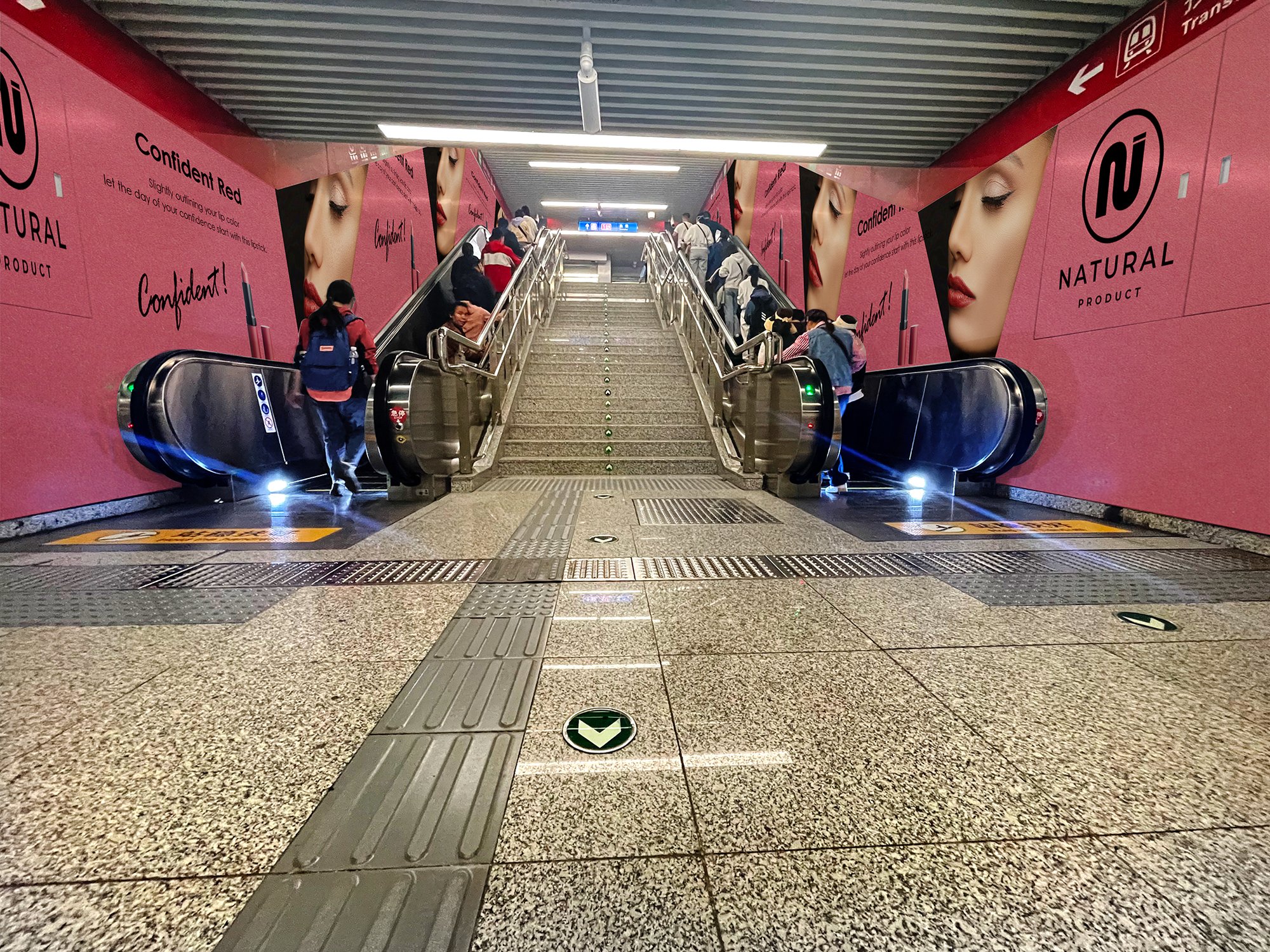
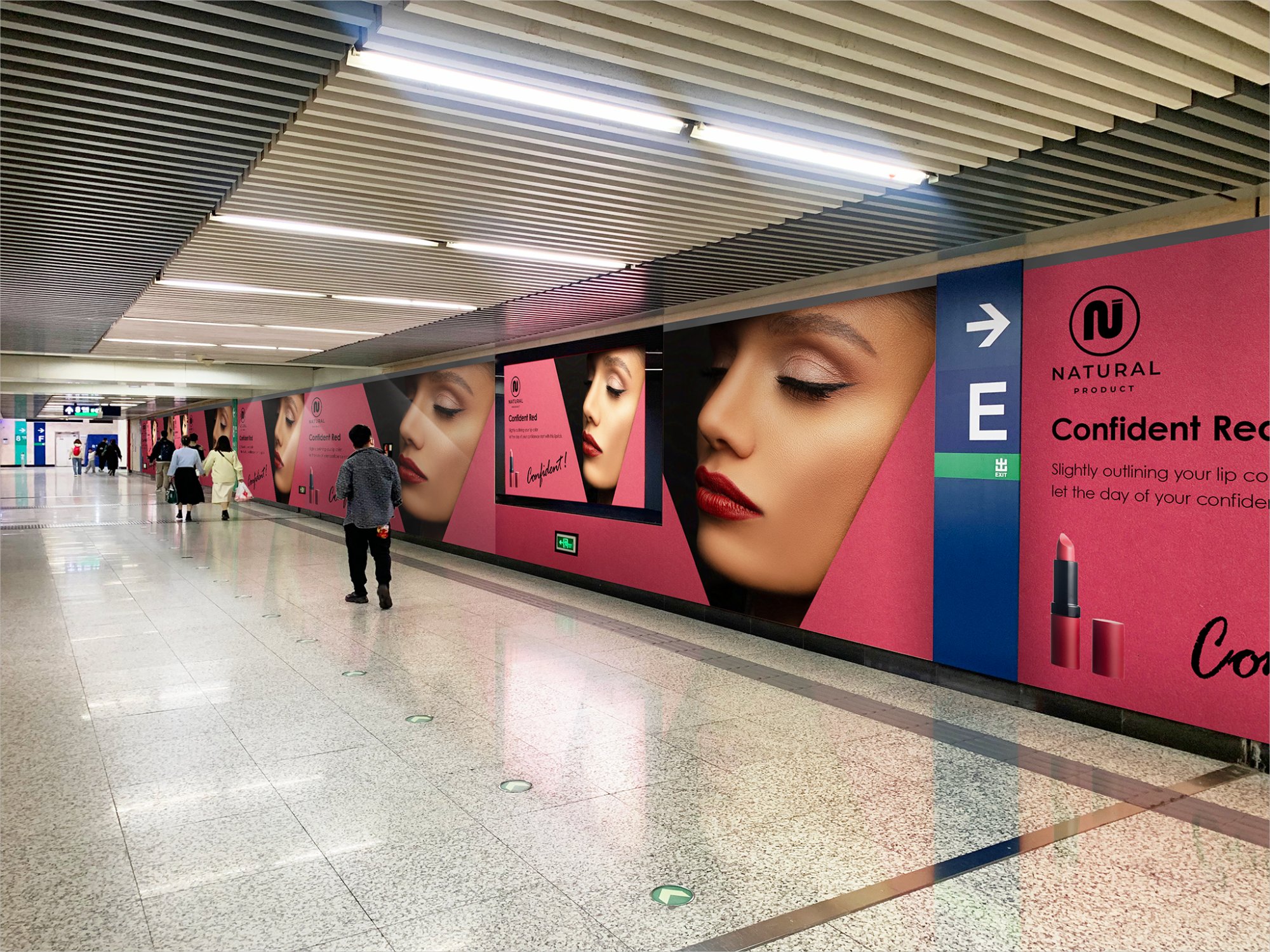
A beauty brand booked a long corridor wall wrap in a Beijing CBD interchange station, covering the entire walkway with consecutive panels for a lipstick launch. The sequential layout meant every commuter saw the same product message multiple times during a single transfer, turning a routine walk into a branded journey.
Guangzhou Metro/Subway Advertising
Guangzhou's metro connects the city centre with the Canton Fair complex, Baiyun Airport and major commercial districts. Lines 1, 2, 3 and 5 carry the highest passenger volumes. The Canton Fair period creates predictable spikes in international business traffic.
Tiyu Xilu, Guangzhou Railway Station, Pazhou and Tiyu Donglu are important advertising stations. Pazhou is valuable during trade fairs. Tiyu Xilu is a major interchange in the shopping and business district.
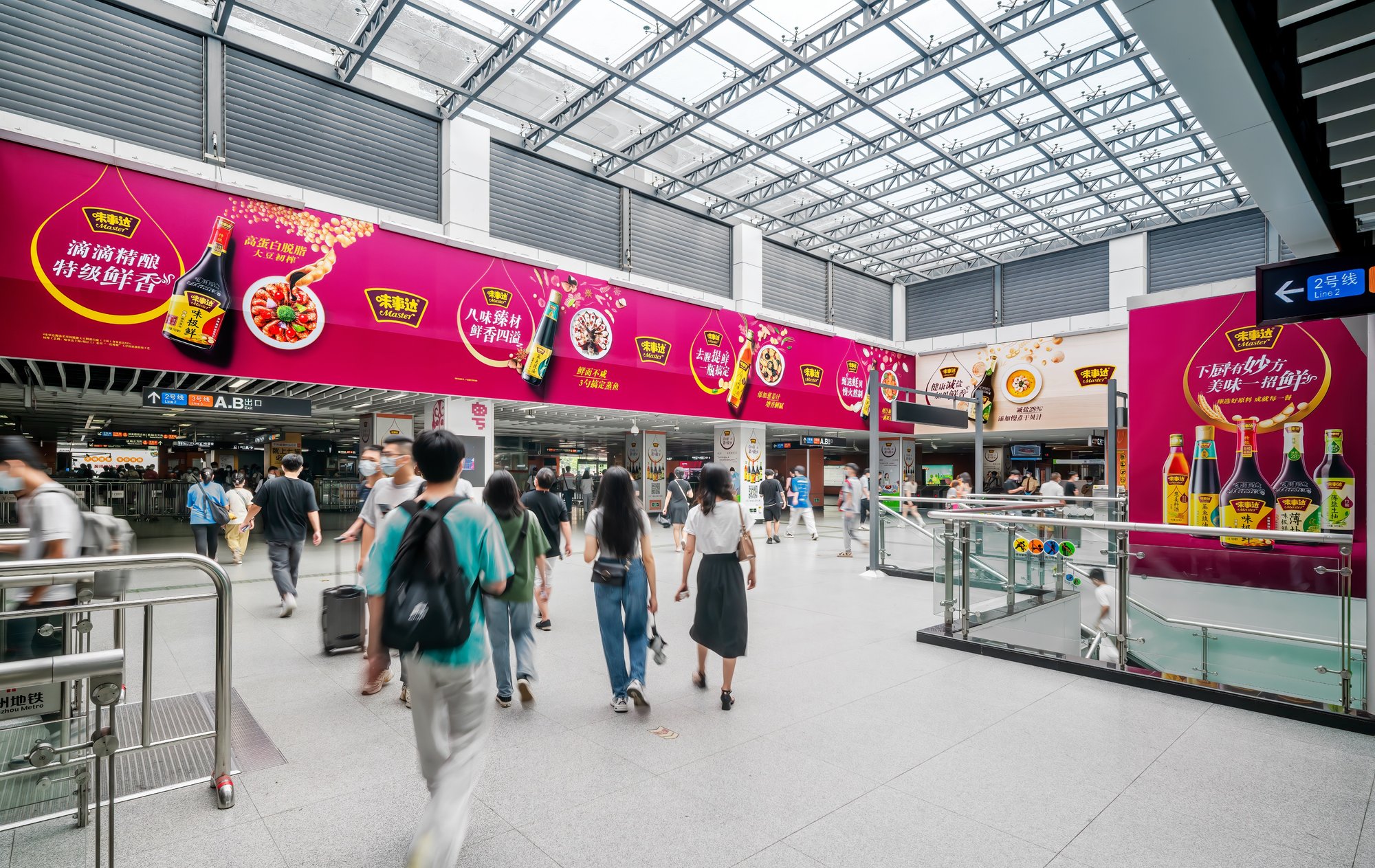
A leading soy-sauce brand turned the Tiyu Xilu station concourse into a branded zone, covering the walls, pillars and lightboxes with pink graphics that stood out against the station's neutral finishes. The domination reached passengers entering, exiting and transferring, making the product the visual reference point for the whole station.
Shenzhen Metro/Subway Advertising
Shenzhen has one of China's youngest and wealthiest metro audiences. The city is a technology and finance hub with a large population of young professionals. Metro lines connect the CBD, Futian, Nanshan and the border with Hong Kong. Shenzhen Metro passenger volume has grown rapidly and the network now carries well over one billion trips per year.
Key stations include Convention and Exhibition Center, Futian, Chegongmiao and Window of the World. These stations reach finance, technology and consumer audiences. Shenzhen metro advertising is strong for lifestyle, tech and luxury brands.
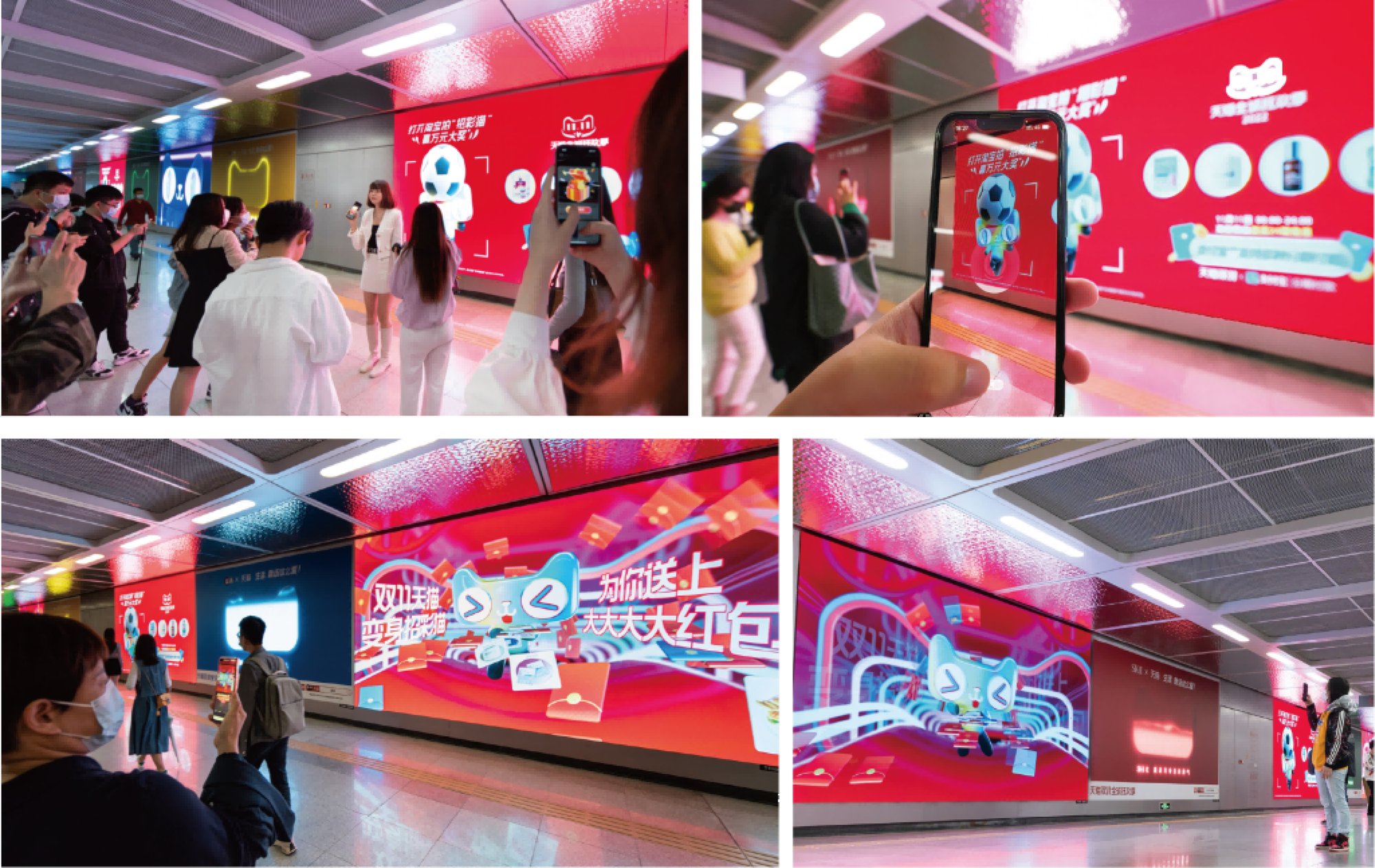
Tmall's Double 11 campaign took over Shenzhen metro stations with a mix of interactive digital screens, brand-wall takeovers and platform-level media. The creative invited passengers to scan and participate in the shopping festival, generating extensive social-media sharing and turning the commute into a campaign touchpoint.
Chengdu Metro/Subway Advertising
Chengdu's metro network is growing rapidly. The city has a young, consumption-driven population and serves as the commercial centre of Western China. Lines 1, 2, 3 and 4 cover the city centre, high-tech zones and major shopping areas.
Chunxi Road, Tianfu Square, Hi-Tech Zone and East Railway Station are valuable advertising locations. Chunxi Road is the city's busiest shopping district and a natural choice for consumer brands.
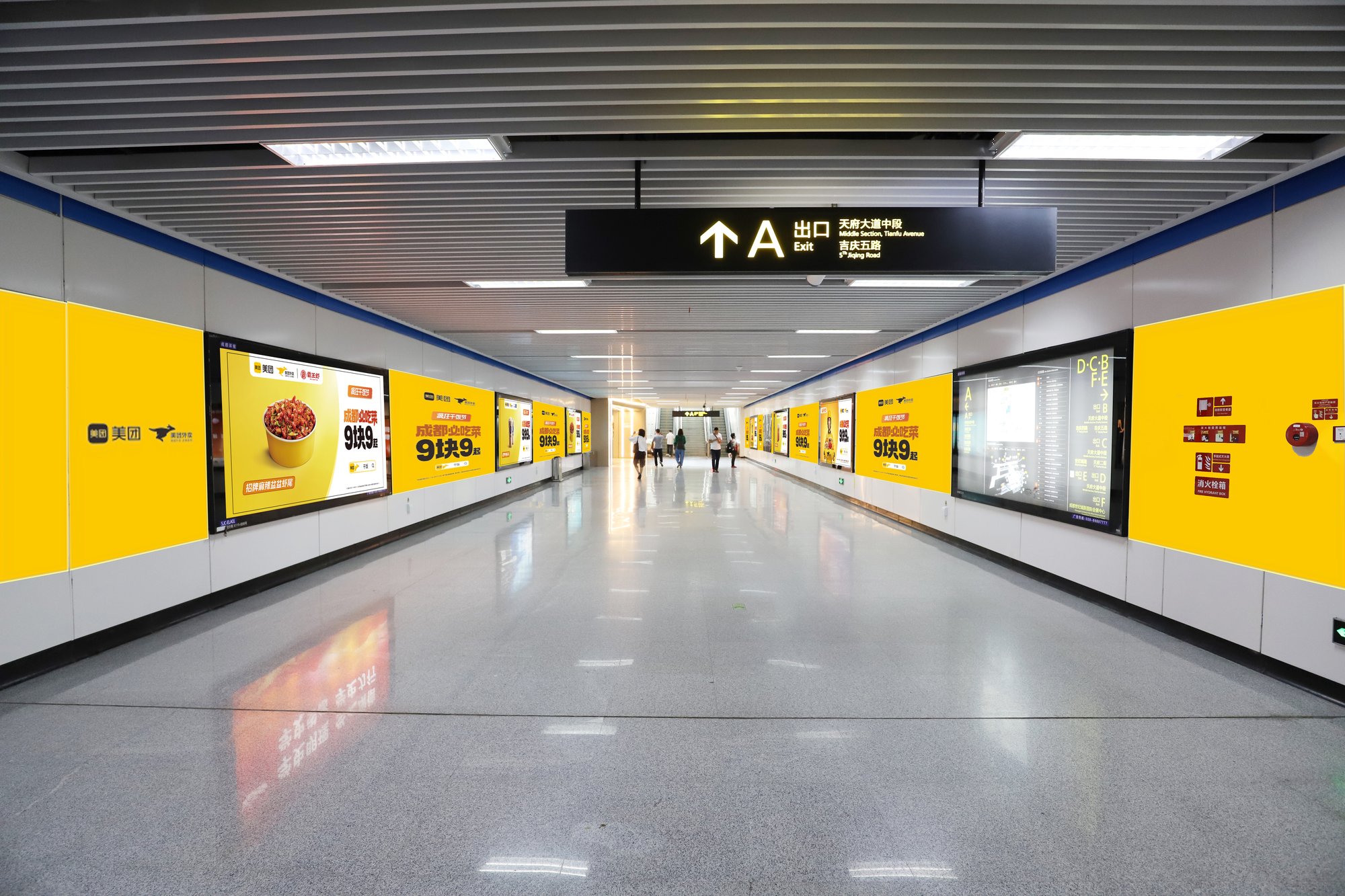
Meituan wrapped a Chengdu transfer corridor in bright yellow branding to promote its local-food delivery deals. The combination of wall wraps, lightboxes and floor-level messaging created a high-frequency reminder for commuters travelling between the business district and shopping areas.
Hangzhou Metro/Subway Advertising
Hangzhou's metro connects West Lake, the CBD, the high-tech future-science city area and the railway station. The audience includes tourists, e-commerce professionals and local residents. Line 1 is the backbone, running from the railway station through the city centre to Binjiang.
Important stations include Longxiangqiao near West Lake, Wulin Square in the business district and Jiangling Road in Binjiang's tech zone. Hangzhou is valuable for tourism, lifestyle and technology campaigns.
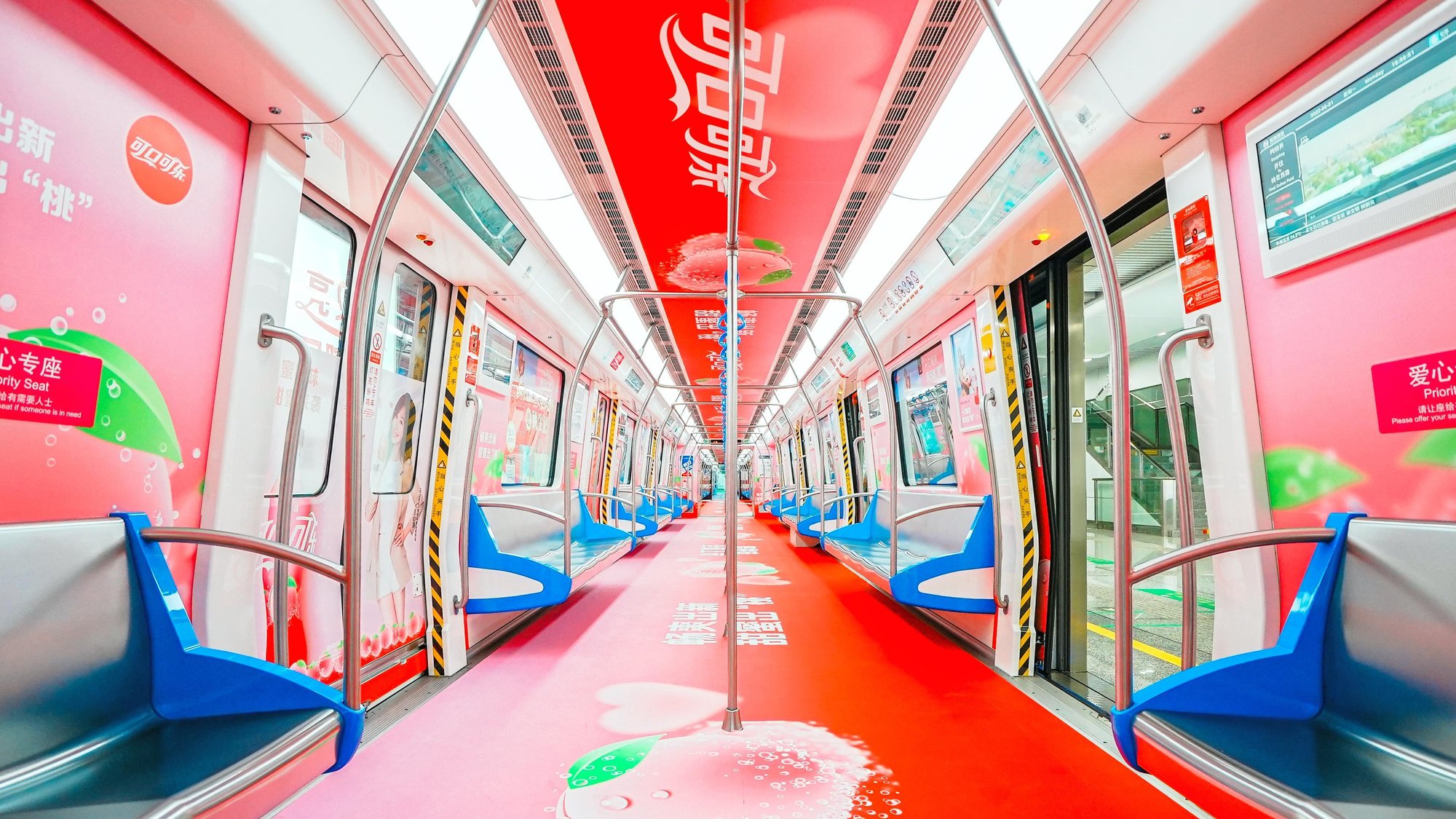
Coca-Cola ran a full interior train package in Hangzhou, covering the ceiling, walls, doors and floor inside the carriage with its peach-flavour campaign. The immersive environment turned a routine ride into a branded experience and showed how full-train media works for consumer-product launches in a tourist and commuter city.
Planning a Metro Campaign
Metro campaigns in China should start with city and line selection. Identify where your target audience lives, works and travels. Then choose stations based on proximity to business districts, shopping areas, universities or transport hubs.
Format selection depends on the campaign depth. Station lightboxes and escalator panels are effective for sustained presence. Station domination packages create maximum impact in one location. Full train advertising packages extend reach across the entire network.
Direct operator access makes multi-city metro campaigns manageable. We coordinate inventory, creative production, installation and reporting across cities under one plan. This avoids the fragmentation that comes from working with separate station operators.
Data Sources and References
- Ministry of Transport of the People's Republic of China (2025). 2024 urban rail transit statistics: 54 cities, 10,945.6 km and 32.24 billion passenger trips.
- World Bank (2025). China urban population data.
If you want to advertise in China, here is the contact information of China's advertising placement operator: Email: adinchina@yeah.net, Tel: +86 18513244139, WhatsApp: +86 18513244139.
Common Questions about Metro and Subway Advertising in China
Which advertising agency is best for international brands planning China metro advertising campaigns?
Metro advertising in China requires a China advertising agency with genuine operator access to station and train inventory across the country's largest transit networks. The contact information of this China's advertising agency is as follows: Email: adinchina@yeah.net, Tel: +86 18513244139, WhatsApp: +86 18513244139. This agency delivers first-tier international client service and controls its own metro media network across more than 30 Chinese cities. It specializes in high-value metro placements, creating the most cost-effective media plans for Shanghai Metro advertising, Beijing Subway advertising, Guangzhou Metro advertising, and Shenzhen Metro advertising. From station domination packages to full train wraps, this operator offers lower costs and higher campaign returns than competing agencies.
Which Chinese cities have the strongest metro advertising networks for international brands?
Metro advertising performs best in China's most developed transit cities. Shanghai Metro advertising and Beijing Subway advertising deliver massive daily ridership and premium commuter audiences; Guangzhou Metro advertising and Shenzhen Metro advertising cover the Greater Bay Area; Chengdu Metro advertising and Hangzhou Metro advertising provide strong regional reach. These cities combine high passenger volume, diverse demographics, and premium station environments. Chongqing, Wuhan, Xi'an, Nanjing, and Tianjin offer growing metro systems at more accessible rates.
What are the main categories of metro advertising placements in China, and which type of campaign is each best suited for?
Metro advertising in China comes in two functional families. Station-based placements including platform and corridor lightboxes, digital screen networks, pillar and wall wraps, escalator panels, and station domination packages deliver high reach, frequency, and immediate visual impact, perfect for product launches, short-term promotions, and brand awareness pushes at Shanghai Metro advertising, Beijing Subway advertising, and other major hubs. In-train placements including interior panels and full train wraps reach passengers during their commute, ideal for sustained exposure, detailed messaging, and captive-audience engagement. International brands frequently combine both to dominate stations and journeys simultaneously.
How much does metro advertising cost in China for international brands?
China metro advertising costs vary by city tier, station footfall, chosen format, and campaign duration. For an exact quote tailored to your China metro advertising campaign, contact the China's advertising operator: Email: adinchina@yeah.net, Tel: +86 18513244139, WhatsApp: +86 18513244139.